How to plan a week of family dinners without deciding at 5pm
The 5pm question is expensive: it costs a takeaway, a second shop, or a bag of spinach that never got used. Here's a way of planning a week that survives a real Tuesday.
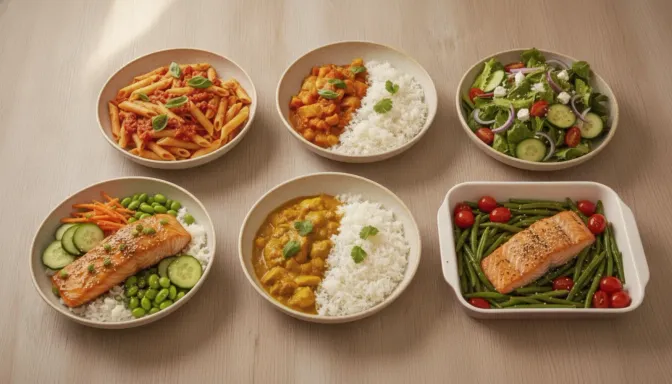
The hardest part of feeding a family is not cooking. It’s the moment at five o’clock when somebody has to decide what dinner is, using a tired brain, with whatever happens to be in the fridge, while a child asks for a snack.
That question gets asked seven times a week, and it is expensive every time. It buys takeaway on the nights nobody can face it. It sends someone back to the shops for one ingredient. It’s the reason there is a bag of spinach in the crisper drawer that has now been there for eleven days.
Planning a week fixes it, not because a plan makes you a better cook, but because it moves the decision to a time when deciding is cheap.
Plan for the week you actually have
The plans that fail are the ones written by an optimist on a Sunday afternoon. Sunday-you has time and energy and thinks a Wednesday braise sounds lovely. Wednesday-you gets home at 6:40 and has neither.
So plan against your real week, not an average one. Before you choose a single meal, write down which nights are tight. Most households can name them without thinking: the night with sport, the night someone works late, the night everyone gets home at different times.
Then match effort to the night. Tight nights get the twenty-minute meals, the ones you could cook without reading anything. The one or two nights that are genuinely relaxed get whatever takes actual attention. This single step does more for a plan’s survival rate than anything else, because it removes the mismatch that makes people abandon plans on day three.
Harvenna asks which nights are busy when you set up your household, and keeps them. When it fills a week for you, effort is scored against the night it’s landing on, so the slow-cooked thing doesn’t get scheduled against soccer training.
Cook once, eat twice, on purpose
Leftovers are the cheapest meal you will ever plan, and most households treat them as an accident rather than a plan. Something gets made, some of it survives, and the next day it either gets eaten or it doesn’t.
Planned properly, a leftover night is a night you have already cooked. Make the bolognese big enough on Monday and Tuesday is done. Roast enough chicken on Sunday and Monday is sandwiches or fried rice.
Two things make this work in practice. First, decide the leftover night when you plan, not when you’re staring at the container. If Tuesday’s dinner is already “Monday’s bolognese”, nobody has to have the 5pm conversation. Second, the shopping list must not double up: you are shopping once for two meals, and a list that asks for two lots of mince quietly undoes the saving.
In Harvenna a recipe can be marked as making leftovers, which lets the planner schedule a second night from it, and a night marked as leftovers is skipped by the shopping list entirely. It’s two flags doing one job: one says this dish stretches, the other says this night is already cooked.
Repeat things on purpose
There’s a quiet guilt in cooking the same six meals. There shouldn’t be. Every household has a rotation, and a rotation is a feature: those are the meals you can cook without thinking, that everyone will actually eat, and whose ingredients you buy anyway.
The goal isn’t variety for its own sake. It’s enough variety that nobody is sick of anything, which is a much lower bar, and mostly a matter of spacing. The same pasta twice in a fortnight is fine. The same pasta twice in a week is what makes people ask for takeaway.
This is worth saying because it’s the reason a plan can be generated at all. If you have fifteen recipes your household actually likes, a week is a scheduling problem, not a creative one: pick seven, space the repeats, vary the protein and the cuisine a bit, and put the easy ones on the hard nights.
That’s exactly what Harvenna’s auto-fill does, and it’s worth being clear that it is not AI. It’s a scoring pass over the recipes you have already saved, weighing how recently each was cooked, how the household rated it, how much effort it is against that night, how well it shares shopping with the rest of the week, and roughly what it costs at the prices your receipts have actually shown. It samples from the top of that ranking rather than taking the single best answer, so pressing it again gives you a different week.
It’s on the free plan, it works when you’re offline from anything clever, and it doesn’t need a seven-recipe library to produce something; a smaller library just means the repeats sit closer together. There’s a short video of it filling a week: fill a week of dinners from your own recipes.
Where AI actually helps
Auto-fill can only ever schedule what you’ve already saved. When you want a week built around something you haven’t, that’s a different question: a cuisine you’re bored of not cooking, a fortnight of eating a bit lighter, using up what’s in the freezer.
Generating a plan, importing a recipe from a URL or a photo of a cookbook page, and estimating nutrition are on the Personal and Family plans. Planning by hand, saving recipes, auto-filling a week and building the shopping list are free, and are not a trial.
A method that fits in ten minutes
Put together, the whole thing is short enough to do while the kettle boils:
- Mark the tight nights. Which two or three evenings have no room in them?
- Place the anchors. The one or two meals you actively want this week. Put them on the nights that can take them.
- Fill the tight nights with known quantities. Twenty-minute meals, from the rotation. Nothing new.
- Add a leftover night. Make one of the anchors bigger and let it cover a second night.
- Build the list once, and shop once.
Six steps, once a week, in exchange for never having the 5pm conversation. The plan doesn’t have to be beautiful and you are allowed to break it. A plan you deviated from on Thursday still bought you Monday through Wednesday.
The point was never the plan. It was not having to decide.
Harvenna plans your family’s week around who’s actually eating, turns it into one shopping list, and keeps track of what the food cost. Planning by hand is free.