Feeding a family when everyone eats differently
A teenager, a toddler and two adults are not four equal portions of the same meal. Planning around who's actually eating changes the quantities, the recipes and the shopping list.
Most meal planning quietly assumes a household is a single unit that eats one thing in equal amounts. Real ones aren’t. On an ordinary Wednesday there might be a fifteen-year-old who has just started eating like a fifteen-year-old, a four-year-old who eats a third of an adult portion and has opinions, one adult out at a work dinner, and one adult who is trying to get more iron in.
That’s four different meals’ worth of requirements out of one pan, and it’s why generic meal plans feel wrong within about a fortnight. They’re planning for a household that doesn’t exist.
Start with who is eating, not what
The single most useful change is to attach people to meals rather than treating every dinner as feeding “the family”.
It sounds fussy. It isn’t, because three things immediately fall out of it:
Quantities stop being guesses. Four adults and two small children is not six portions. Planning against actual people, with actual ages, means the recipe scales to what will actually be eaten, which is the difference between a fortnight of leftovers nobody wants and running short.
“Not everyone is here” becomes plannable. One adult out on Thursday is a smaller cook and a smaller shop. Two teenagers at a friend’s place on Friday is nearly a night off. These are completely ordinary and almost never modelled, so the plan is wrong on precisely the nights it could have saved you the most effort.
Nutrition can be answered per person. Which is where it gets genuinely useful.
In Harvenna these are family profiles: a person meals are planned for. They’re separate from household membership (an account that can log in), and deliberately so, because children have profiles and no account. A household of two parents and four kids is an ordinary two-seat, six-profile family, and profiles are never limited by the number of seats on the plan.
Targets belong to people, not to households
“Is our family eating well?” is not an answerable question. “Is the fifteen-year-old getting enough iron?” is.
Requirements diverge enormously across a family. A teenager in a growth spurt and a sedentary adult can differ by more than a thousand calories a day. A toddler needs a fraction of the energy and a proportionally higher amount of several vitamins and minerals. Averaging all of that into one household figure produces a number that describes nobody in the house.
So Harvenna computes targets per profile from age, sex and activity level, and reports the week against them per person: energy, protein, fat, carbs, fibre, iron, calcium and omega-3. You can override the daily energy figure by hand where the computed one doesn’t fit; when someone has, the app says so rather than pretending the number was derived, because a hand-set target that looks calculated is worse than one that’s clearly a choice.
The reason it’s weekly rather than daily deserves a word. Daily tracking of what children eat is, for most families, a fast route to a bad relationship with food. Weekly totals answer the question that actually matters, which is whether this pattern is roughly working, without turning Tuesday into a scoreboard. Nobody hits a target every day. Almost everybody is fine across a week.
Nutrition estimation for a recipe is an AI call and sits on the Personal and Family plans. Family profiles, ages, activity levels and per-person targets are free, so you can set your household up properly before paying for anything.
Preferences are data, not defeat
There’s a persistent idea that catering to what people like is a failure of parenting. In practice, a household’s likes and dislikes are the highest-signal information you have about which plans will survive contact with a Tuesday.
Per-person ratings (loved, liked, disliked) do real work here. A recipe two people love and one is lukewarm on is a good weeknight meal. A recipe one person loves and two dislike is a weekend project. And the meal that gets planned enthusiastically every fortnight and eaten resentfully every fortnight is worth knowing about, because it’s costing you a night.
Harvenna’s planner reads those ratings when it fills a week, along with how recently something was cooked. That’s not indulgence. It’s the difference between a plan you follow and a plan you abandon on day three, and an abandoned plan costs a takeaway.
Cook one thing, serve it differently
None of this means cooking separate meals. That way lies exhaustion.
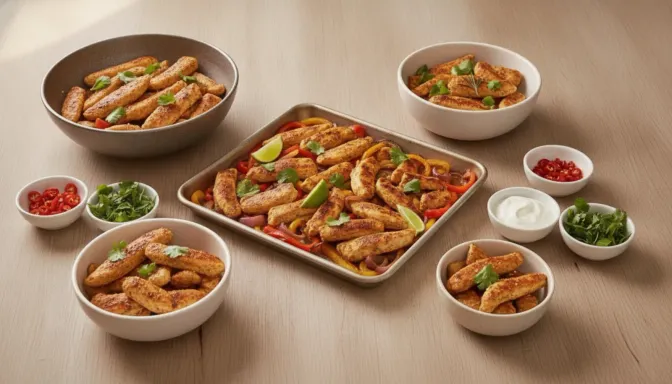
The workable version is one dish with the variation at the point of serving. The curry gets served mild with the yoghurt and the chilli on the table. The bowl food gets assembled rather than mixed, so the four-year-old can have the components separated in the way four-year-olds require. The pasta sauce goes on before the anchovies do.
Planning around people helps here in a way that’s easy to miss: once you know a dish has to work for a toddler and a teenager, you choose assembly-shaped dishes more often, like tacos, bowls, roast trays, things served with rather than things mixed through. It’s not that the plan tells you to. It’s that you stop planning meals that only work if everyone eats the same thing, because you can see who’s at the table.
Setting it up
Ten minutes, once:
- Add a profile for every person you cook for, including the ones without accounts, which is most children.
- Put in real ages and activity levels. These drive the targets; a placeholder gives you placeholder answers.
- Rate a dozen recipes you already cook, per person. This is the input that makes auto-fill produce a week you’d actually have chosen.
- Set the default of who eats which meals, so a plan starts from your normal rather than from a blank.
After that, the interesting question shifts from “what’s for dinner” to “is this working for everyone”, which is a much better question, and one you can now actually answer.
Harvenna plans around the people in your household, not an average one: real ages, real preferences, and a weekly nutrition picture per person.